Designing with Empathy: How the Therapie Mental Health Presentation Template Transforms Sensitive Communication
In an era where mental health awareness is no longer a niche topic but a central pillar of corporate wellness, education, and public discourse, the way we communicate these sensitive subjects matters more than ever. Whether you are a therapist presenting to a board of directors, a startup pitching a wellness app, or an educator explaining psychological concepts to students, the visual medium you choose sets the tone for the entire conversation. This is where specialized tools like the Therapie Mental Health Presentation Template become essential. It is not merely a collection of slides; it is a structured framework designed to bridge the gap between complex clinical information and accessible, empathetic communication.
Understanding how to leverage such a template requires looking beyond aesthetics. We must explore why design psychology matters in mental health contexts, how versatile templates serve diverse industries from creative agencies to healthcare providers, and the practical technical features that make customization both efficient and professional. By examining the "Therapie" template as a case study, we can better understand the intersection of visual design and emotional intelligence in modern presentations.
The Psychology of Visual Communication in Mental Health
When discussing mental health, the audience’s cognitive load is often high. Topics ranging from anxiety and depression to organizational burnout require processing emotional content alongside factual data. If a presentation is cluttered, chaotic, or visually aggressive, it can inadvertently trigger stress or disengagement. Conversely, a well-designed slide deck acts as a cognitive scaffold, helping the audience process information without feeling overwhelmed.
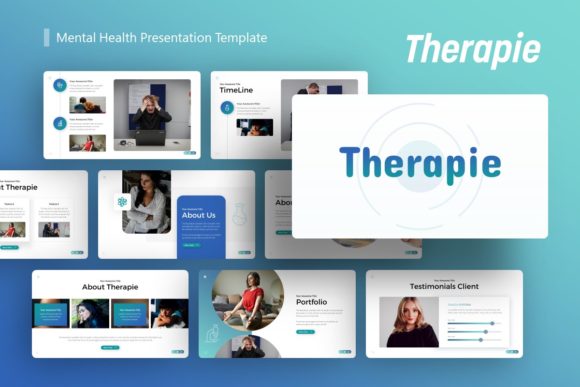
The Therapie template exemplifies this principle through its use of whitespace, calming color palettes, and pixel-perfect illustrations. These are not arbitrary artistic choices; they are functional design elements. Whitespace reduces visual noise, allowing key messages to breathe. Soft, organic shapes and handcrafted infographics soften the clinical edge of medical or psychological data, making it feel more human and approachable. For general readers and professionals alike, understanding this dynamic is crucial. You are not just arranging text and images; you are curating an emotional environment that facilitates learning and openness.
Bridging Clinical Accuracy and Emotional Safety
A common misunderstanding in professional settings is the belief that "professional" means "sterile." In mental health communication, sterility can be perceived as coldness or indifference. The challenge lies in maintaining clinical accuracy while projecting warmth. This template addresses that balance by providing picture placeholders and vector icons that are editable yet stylistically consistent. This ensures that even when users customize content for specific needs—such as a corporate HR briefing versus a patient intake session—the underlying visual language remains supportive and safe.
Versatility Across Industries and Use Cases
While named for mental health, the utility of the Therapie template extends far beyond therapy clinics. Its structure supports a wide variety of purposes, reflecting the reality that mental wellness is now integrated into almost every sector of modern life. Understanding this versatility helps users maximize their investment in digital assets.
- Creative Agencies and Portfolios: Creatives often deal with high-stress environments and subjective feedback. Using a mental health-themed template for agency profiles or portfolios signals a commitment to sustainable creativity and team well-being, differentiating the agency in a competitive market.
- Corporate and Business Profiles: Modern companies are increasingly evaluated on their ESG (Environmental, Social, and Governance) criteria, which includes employee welfare. This template allows businesses to present internal wellness initiatives, diversity reports, or culture decks with the gravity and care they deserve.
- Startups and Pitch Decks: Health-tech and wellness startups face the unique challenge of selling empathy. Investors need to see financial viability, but they also need to trust the founder's understanding of the user's emotional journey. A pitch deck built on this template conveys that duality effectively.
- Education and Photography: Educators explaining developmental psychology or photographers showcasing therapeutic art projects benefit from layouts that prioritize imagery and narrative flow over dense bullet points.
This adaptability stems from the template’s foundation on Master Slides. Rather than formatting individual slides one by one, Master Slides allow global changes to fonts, colors, and logos across all 36 slides instantly. This technical feature enables a corporate user to rebrand the deck in minutes, transforming a clinical resource into a branded business asset without losing the thoughtful layout architecture.
Technical Features That Enhance Content Delivery
For beginners and experienced presenters alike, the friction of design can distract from the message. The Therapie template is engineered to reduce this friction through specific technical inclusions. Understanding these features helps users distinguish between a generic slide deck and a professional communication tool.
Handcrafted Infographics and Editable Graphics
Data visualization is critical in mental health presentations. Statistics regarding prevalence rates, treatment outcomes, or demographic shifts can be dry and difficult to retain. The inclusion of handcrafted infographics in PowerPoint format transforms abstract numbers into digestible visual stories. Because these graphics are fully resizable and editable, users are not locked into stock representations. A researcher can adjust a chart to reflect new study data, or a nonprofit can modify an infographic to highlight local community statistics, ensuring the content remains relevant and accurate.
Picture Placeholders and Drag-and-Drop Functionality
Imagery in mental health contexts must be chosen with extreme care to avoid stigmatization or triggering reactions. The template’s picture placeholders serve as guides for appropriate image sizing and composition, but they also remind the user to be intentional about visual selection. The drag-and-drop functionality simplifies the technical aspect of replacing preview images with authentic, ethically sourced photography. This ease of use encourages presenters to spend more time selecting the right image rather than fighting with alignment tools.
Comprehensive Documentation and Vector Icons
One of the most overlooked aspects of digital templates is documentation. A robust documentation file acts as a tutorial, guiding users through the customization process. This is particularly valuable for those who may not be design experts but need to produce high-quality materials. Coupled with a library of vector icons, users have a self-contained ecosystem for creating visuals. Vector icons scale infinitely without losing quality, ensuring that whether the presentation is viewed on a smartphone or projected in a lecture hall, the visual integrity remains intact.
Best Practices for Customizing Mental Health Content
Having access to a powerful tool like the Therapie template is only the first step. To truly serve your audience, you must apply best practices in content adaptation. Here are practical guidelines for using this template effectively:
- Audit Your Imagery: Remember that demo images are for preview only. Replace them with diverse, inclusive, and non-stigmatizing visuals. Avoid clichés like people holding their heads in despair; opt for images that convey resilience, connection, and hope.
- Simplify Complex Data: Use the 36-slide variety to break down heavy topics. Do not cram multiple concepts onto one slide. Utilize the handcrafted infographics to isolate single data points or processes, giving the audience time to absorb each element.
- Maintain Consistency: Leverage the Master Slide feature to ensure your branding aligns with the template’s calming aesthetic. High-contrast neon colors or aggressive fonts may clash with the template’s intended mood and undermine the message of safety.
- Cite Sources Clearly: In mental health presentations, credibility is paramount. Use the clean typography hierarchy provided by the template to distinguish between anecdotal evidence, clinical research, and organizational policy clearly.
The Broader Significance of Intentional Design
Ultimately, adopting a specialized presentation template like Therapie represents a shift in how we value communication. It acknowledges that form and function are inseparable, especially when dealing with human vulnerability. In a world saturated with information, clarity is a form of kindness. When a presenter takes the time to organize their thoughts within a framework designed for empathy, they signal respect for their audience’s time and emotional capacity.
Whether you are building a personal portfolio that highlights your advocacy work, launching a startup dedicated to psychological innovation, or simply updating your company’s internal training materials, the tools you use shape the outcome. The Therapie Mental Health Presentation Template offers more than just 36 customizable slides and vector icons; it offers a pathway to more compassionate, effective, and professional storytelling. By mastering these tools and understanding the principles behind them, we contribute to a culture where mental health is discussed not just with accuracy, but with the dignity and care it deserves.