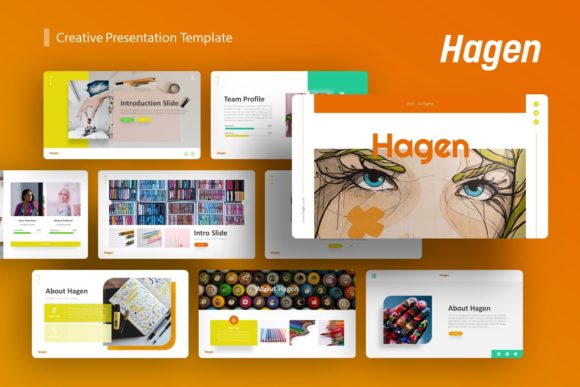
Hagen Creative Presentation Template: A Strategic Asset for Professional Communication
In the modern business landscape, a presentation deck is rarely just a collection of slides; it is a strategic instrument used to secure funding, define brand identity, or articulate complex value propositions. The Hagen Creative Presentation Template serves as more than a visual backdrop—it functions as a structural framework that guides narrative development and ensures consistency across diverse communication channels. For professionals ranging from startup founders to creative directors, selecting this template is a decision rooted in efficiency and brand alignment rather than mere aesthetics. Understanding its capabilities allows users to leverage design as a competitive advantage, transforming standard corporate updates or pitch decks into compelling, results-oriented narratives.
Strategic Alignment Across Diverse Business Functions
The versatility of the Hagen Creative Presentation Template lies in its ability to adapt to distinct operational contexts without losing coherence. When evaluating whether this asset fits your current needs, consider how its structure supports specific organizational goals. It is engineered to serve multiple high-stakes environments, each requiring a different balance of data, imagery, and persuasion.
- Creative Agencies and Portfolios: For agencies, the template acts as a proof-of-concept. The pixel-perfect illustrations and resizable graphics demonstrate an eye for detail before a single word is spoken. This is critical when selling design services, as the medium itself validates the message.
- Startup Pitch Decks: Investors review hundreds of decks annually. Hagen provides a clean, professional hierarchy that prevents information overload. By utilizing pre-structured layouts, founders can focus on refining their business model and financial projections rather than wrestling with alignment tools, ensuring the narrative flow remains logical and persuasive.
- Corporate Profiles and Business Reporting: Established companies require templates that accommodate dense information without appearing cluttered. The handcrafted infographics included in Hagen allow for the visualization of quarterly results or operational workflows, making abstract data tangible for stakeholders and board members.
- Personal Branding and Freelancing: Individual professionals can use the 36-slide variety to create modular portfolios. Instead of rebuilding a deck for every prospect, freelancers can maintain a master file where specific sections are toggled on or off depending on the client’s industry, ensuring relevance while maintaining personal brand consistency.
Leveraging Technical Features for Operational Efficiency
Efficiency in presentation design is not about speed alone; it is about reducing cognitive load for both the creator and the audience. The technical architecture of the Hagen Creative Presentation Template is designed to support sustainable workflows. With 36 unique slides per template, users have sufficient variety to avoid repetition while staying within a unified visual system. This breadth prevents the "copy-paste fatigue" that often degrades the quality of longer presentations.
Crucially, the template is based on Master Slides. This is a non-negotiable feature for teams and organizations planning to use the deck long-term. Changes made to a Master Slide propagate globally, ensuring that logo updates, color palette shifts, or font adjustments are applied instantly across all relevant slides. This eliminates version control errors and ensures brand compliance without manual auditing. Furthermore, the inclusion of editable, resizable vector graphics means that visuals remain crisp at any projection size or aspect ratio, preserving professional integrity whether viewed on a mobile device or a conference hall screen.
The drag-and-drop picture placeholders further streamline the production process. However, strategic users should view these not just as convenience features but as constraints that enforce visual discipline. By adhering to predefined image ratios and placements, presenters maintain a rhythmic visual cadence that keeps audiences engaged. The included documentation file serves as a technical manual, reducing onboarding time for new team members and ensuring that the template is utilized to its full potential rather than being modified haphazardly.
Intentional Design vs. Decorative Application
A common pitfall in adopting premium assets like Hagen is treating them as decorative wrappers rather than communication tools. To derive genuine value, one must approach the template with intentionality. Before opening the PowerPoint .PPTX file, clarify the primary objective of the presentation. Is it to inform, persuade, inspire, or instruct? The answer dictates which of the 36 slides are necessary and which should be discarded.
For example, a photography portfolio requires minimal text and maximum negative space to let images breathe. In this context, the user should prioritize the template’s image-heavy layouts and strip away complex infographic slides that might distract from the visual work. Conversely, a B2B SaaS pitch deck demands trust and clarity. Here, the handcrafted infographics become the hero elements, translating technical specifications into digestible benefits. Using the template intentionally means curating its assets to serve the narrative, not forcing content into attractive but irrelevant layouts.
Consider the role of the vector icons included in the package. Icons function as visual anchors that aid memory retention. Strategically, they should be used consistently to represent recurring concepts throughout the deck. If a specific icon represents "revenue growth" on slide five, it must represent the same concept on slide twenty. This semantic consistency reduces friction for the audience, allowing them to process information faster. Randomly assigning icons based solely on aesthetic preference undermines this cognitive benefit and creates subtle confusion.
Planning for Content Hierarchy and Narrative Flow
The structure of Hagen facilitates better storytelling, but only if the user plans the content hierarchy first. A recommended workflow involves outlining the key messages before applying the design. Map your narrative arc against the available slide types. Identify where data visualization is needed versus where emotional connection through photography is required. This pre-planning phase prevents the "design-first" trap where beautiful slides are created first and content is shoehorned in later, often resulting in disjointed messaging.
When customizing contents, maintain the template’s underlying grid system. While all graphics are editable, respecting the whitespace and alignment guides preserves the professional polish that makes the template valuable. Deviating from the grid should be a conscious stylistic choice backed by a specific reason, not a result of accidental formatting. This discipline signals attention to detail—a trait highly valued by clients, investors, and employers.
Risk Mitigation and Contextual Awareness
While Hagen offers significant advantages, relying on it without contextual awareness introduces risks. The most immediate concern involves licensing and asset management. Users must understand that demo images are for preview purposes only and are not included in the files. Failing to budget time or resources for high-quality, licensed replacement imagery can result in a presentation that looks unfinished or legally precarious. Always verify image rights and ensure replacements match the lighting and style of the template’s original aesthetic to maintain immersion.
Another risk is over-standardization. Because the template is comprehensive, there is a temptation to use it for every possible scenario. However, a highly stylized creative template may be inappropriate for conservative industries like legal services or government contracting. Assess the cultural expectations of your audience before deployment. If the Hagen aesthetic clashes with the recipient’s norms, the design becomes a barrier rather than a bridge. In such cases, significant modification or a more subdued alternative may be strategically superior.
Additionally, avoid becoming dependent on the template’s specific infographic styles. While the handcrafted vectors are excellent, they may not perfectly represent niche industry metrics. Be prepared to create custom charts that adhere to the template’s color palette and typography even if the specific shape isn't included. The goal is visual language consistency, not rigid adherence to pre-made assets. Blindly using generic infographics because they are available can lead to misrepresentation of data, which damages credibility far more than a simple bar chart would.
Long-Term Value and Scalability
Investing time in mastering the Hagen Creative Presentation Template yields compounding returns. By establishing a customized master version tailored to your organization’s specific branding guidelines, you create a scalable communication asset. New employees can produce on-brand presentations immediately, reducing training overhead. Marketing teams can repurpose sales decks for webinars or social media snippets without redesigning from scratch. This operational leverage transforms a one-time purchase into a long-term productivity multiplier.
Furthermore, the template encourages better design literacy among non-designers. Working within a well-crafted system teaches principles of hierarchy, contrast, and spacing through practice. Over time, teams develop an intuitive sense of what works visually, leading to better communication outcomes even outside the template. The constraints of the 36-slide library force editors to be concise and selective, skills that transfer to email writing, report generation, and verbal communication.
Ultimately, the Hagen Creative Presentation Template is a tool for professional maturity. It bridges the gap between raw content and polished delivery, allowing entrepreneurs, marketers, and creators to compete at a higher level. Success depends not on the file itself, but on the strategic thought applied to its implementation. By aligning its features with clear business objectives, respecting its structural integrity, and adapting it to specific audience contexts, users can transform standard presentations into powerful catalysts for growth and understanding. The template provides the canvas; your strategy provides the art.