Presentation Template - Portfolio: Integrating Madras into Professional Workflows
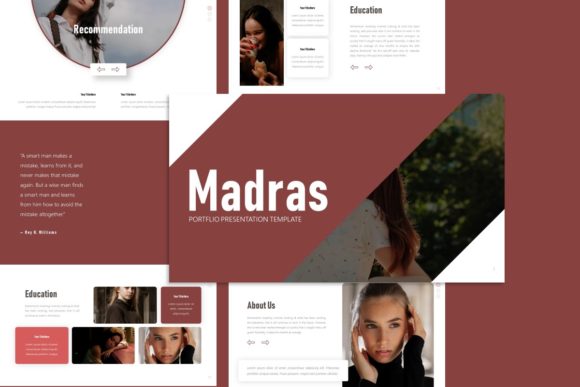
In the modern professional landscape, the ability to communicate value visually is as critical as the work itself. Whether you are a creative agency pitching a new campaign, a startup seeking seed funding, or a freelancer showcasing recent projects, the structure of your narrative determines your success. The Presentation Template - Portfolio serves as more than just a collection of slides; it is a strategic framework designed to streamline the communication process. Specifically, introducing the Madras Portfolio Presentation provides a versatile foundation that adapts to diverse needs, from corporate profiles to personal branding. Understanding how to integrate this tool into your broader workflow ensures that your presentations are not only aesthetically pleasing but also functionally effective and efficient to produce.
Defining the Role of a Structured Portfolio Template
A common misconception is that presentation templates are merely decorative starting points. In practice, a high-quality Presentation Template - Portfolio acts as a container for strategic thinking. It forces organization before content creation begins. When utilizing a comprehensive system like Madras, which includes 35 distinct slides per template, users are provided with a pre-validated narrative arc. This reduces the cognitive load associated with layout design, allowing professionals to focus entirely on message clarity and data accuracy.
This resource fits into the broader ecosystem of business development and personal branding by standardizing visual output. For agencies and businesses, consistency builds trust. By relying on master slides and pixel-perfect illustrations, teams can ensure that every stakeholder meeting, pitch deck, or project review maintains a cohesive brand identity without requiring constant oversight from a senior designer. The template becomes an operational asset that bridges the gap between raw information and polished communication.
Strategic Application Across Project Lifecycles
The utility of a robust portfolio template extends across the entire lifecycle of a project or business goal. It is not limited to final deliverables but supports planning, execution, and retrospective analysis.
Pre-Project Planning and Pitching
Before a contract is signed or a project is greenlit, the Presentation Template - Portfolio functions as a persuasion tool. Startups and creatives often struggle to articulate their vision to investors or clients. The handcrafted infographics included in the Madras template allow users to visualize complex business models or creative concepts quickly. Instead of spending days designing custom charts, teams can utilize editable vector graphics to map out timelines, market opportunities, and service offerings. This accelerates the proposal phase, enabling faster feedback loops and more agile business development.
During Execution and Stakeholder Updates
Communication during active projects is often fragmented. A standardized template provides a consistent format for progress reports and internal reviews. Because the Madras template is based on master slides, updating recurring elements—such as headers, footers, and color schemes—is instantaneous. This efficiency is crucial for project managers and educators who need to disseminate information regularly. The drag-and-drop picture placeholders facilitate rapid updates, ensuring that stakeholders always have access to current visuals without navigating complex design software.
Post-Project Documentation and Knowledge Sharing
After a project concludes, the same assets used for pitching can be repurposed for case studies and portfolio entries. This continuity creates a seamless archive of work. Freelancers and small business owners can document outcomes using the same visual language they presented initially, reinforcing brand recall. Furthermore, the documentation file included with the template aids in maintaining institutional knowledge, ensuring that future team members understand how to update and adapt the presentation assets for long-term use.
Integration with Existing Tools and Resources
No presentation exists in a vacuum. The effectiveness of the Presentation Template - Portfolio depends on how well it interacts with other tools in your stack. Madras is delivered as a PowerPoint .PPTX file, ensuring broad compatibility across Microsoft Office ecosystems and various third-party presentation platforms. This accessibility is vital for collaborative environments where team members may use different operating systems or software versions.
The inclusion of vector icons and resizable graphics means these assets can be extracted and used in other mediums. Marketers might pull specific infographic elements for social media posts or website banners, creating a unified cross-channel experience. Photographers and visual artists can leverage the high-resolution picture placeholders to create print-ready lookbooks or digital galleries. The key to successful integration is treating the template as a central asset library rather than a static document. By organizing the included files logically within your project management system, you reduce friction when switching between drafting, presenting, and publishing.
Practical Implementation and Workflow Efficiency
To maximize the return on investment when using a Presentation Template - Portfolio, users should adopt a process-oriented approach to customization. While the Madras template is marketed as easy to customize, efficiency comes from disciplined editing rather than random alteration.
- Leverage Master Slides: Always edit global elements through the Slide Master view. Changing fonts, logos, or background colors on individual slides defeats the purpose of a template and introduces inconsistency. Master slide edits propagate instantly across all 35 slides, saving hours of manual formatting.
- Utilize Placeholder Logic: The drag-and-drop functionality is designed for speed. Prepare your images in the correct aspect ratio before inserting them to avoid cropping issues. If the template provides a specific placeholder shape, respect its boundaries to maintain the intended whitespace and alignment.
- Adapt Infographics Intelligently: Handcrafted infographics are powerful, but they must reflect accurate data. Before editing vector shapes, verify your metrics. It is better to simplify a complex chart than to force incorrect data into a pre-designed graphic. Editability should serve clarity, not just aesthetics.
- Maintain File Hygiene: Keep the original documentation file and vector icon pack accessible. As you modify the presentation, save iterative versions. This prevents accidental loss of core structural elements and allows you to revert to a clean state if necessary.
Quality Control and Usability Considerations
When implementing any Presentation Template - Portfolio, quality control is paramount. The Madras template offers pixel-perfect illustrations, but the final output depends on user input. One critical factor to remember is that demo images are for preview purposes only and are not included in the downloadable files. Users must source their own high-quality imagery to match the template’s professional standard. Using low-resolution or poorly lit photos will undermine the premium feel of the layout.
Usability also extends to audience comprehension. While 35 slides provide ample variety, not every presentation requires all available options. Curate the deck ruthlessly. Select only the slides that directly support your narrative goals. Overloading a pitch deck or portfolio with unnecessary variety dilutes the message. The flexibility of the template should be used to enhance focus, not to showcase every possible layout option.
Furthermore, consider the technical environment where the presentation will be displayed. Test the .PPTX file on the actual hardware or platform you intend to use. Font embedding and video playback can vary between devices. Because Madras relies on standard PowerPoint architecture, it generally performs reliably, but verifying compatibility beforehand prevents technical disruptions during critical moments.
Long-Term Value and Adaptation
Investing time in mastering a Presentation Template - Portfolio yields compounding returns. As you become familiar with the Madras structure, the time required to generate new decks decreases significantly. This efficiency allows for more iteration and refinement of the content itself. For educators and trainers, the template can evolve alongside curriculum changes. For businesses, it can scale from early-stage pitch decks to mature corporate profiles without losing brand equity.
The true value lies in the balance between structure and flexibility. By providing a rigorous framework of master slides, infographics, and placeholders, the template handles the heavy lifting of design. This frees professionals to apply their expertise where it matters most: crafting compelling narratives, analyzing data, and building relationships. Whether used for a creative agency, a personal portfolio, or a corporate overview, integrating this template into your workflow transforms presentation creation from a daunting task into a streamlined, repeatable process.